



On March 27, during the 2026 ZGC Forum AI Theme Day, the Zhongguancun Academy and the Zhongguancun Institute of Artificial Intelligence released five research progress. Spanning embodied AI, reinforcement learning, life sciences, foundation models, and social intelligence, these advancements showcase the pioneering exploration of ZGCA and ZGCI in talent cultivation and scientific innovation.
01 From "Action Imitation" to "Physical Awakening"
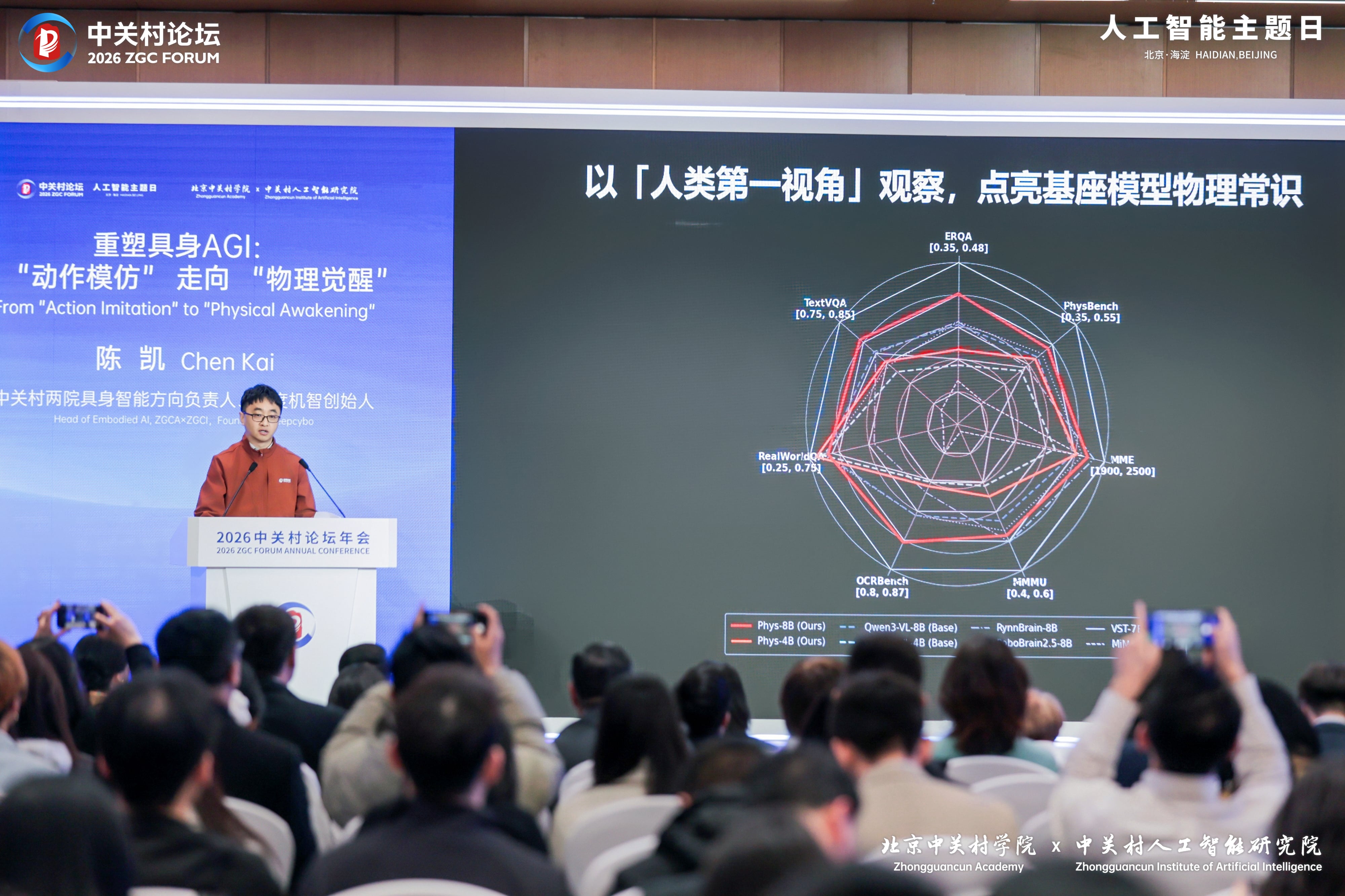
In the evolution of Embodied Intelligence toward Embodied AGI, PhysBrain 1.0 marks a decisive paradigm shifts from 'action imitation' to the 'acquisition of physical common sense.' By developing a data engine that converts massive egocentric human data into multimodal corpora, it provides models with a "physical intuition" that transcends basic code, enabling robots to grasp the underlying logic of the world prior to interaction.
Leveraging this physical awakening, PhysBrain first achieved significant breakthroughs in general Vision-Language Model (VLM) benchmarks, outperforming mainstream base models in dimensions such as spatial reasoning and physical common sense. Consequently, without any action pre-training, it surpassed existing performance limits in authoritative international embodied task evaluations, including SimplerEnv, RoboCasa, and LIBERO.
The ecosystem is powered by three technical pillars: the base model ignites physical common sense through egocentric data injection; the TwinBrainVLA architecture employs 'dual-brain fusion' to mitigate the decline of general capabilities during domain-specific fine-tuning; and the LangForce strategy tackles the 'vision shortcut' challenge from a Bayesian statistical perspective. The exceptional data efficiency of PhysBrain 1.0 proves that physical awakening is the essential key for robots to navigate the real world, accelerating the transition of general-purpose robots from laboratories to large-scale applications.
02 AutoSOTA: Rethinking SOTA Research and Returning to the Essence of Innovation
In AI research, SOTA (State-of-the-Art, referring to AI models that represent the current best performance) is widely regarded as the 'gold standard'for measuring the value of a research contribution. Yet reaching this summit often requires enormous research investment. A top-tier research breakthrough may begin with a brave new idea, but it also depends on months or even years of sustained, high-intensity optimization and refinement. Transformer is a representative example. Since its debut in 2017, researchers around the world have devoted massive amounts of compute and human effort over the following years, exploring a large number of variants before pushing its performance on the General Language Understanding Evaluation benchmark (GLUE) from roughly 75% to over 90%. Although such iterative, incremental optimization is necessary, it also consumes a substantial share of the time and energy that human scientists could otherwise devote to original exploration.
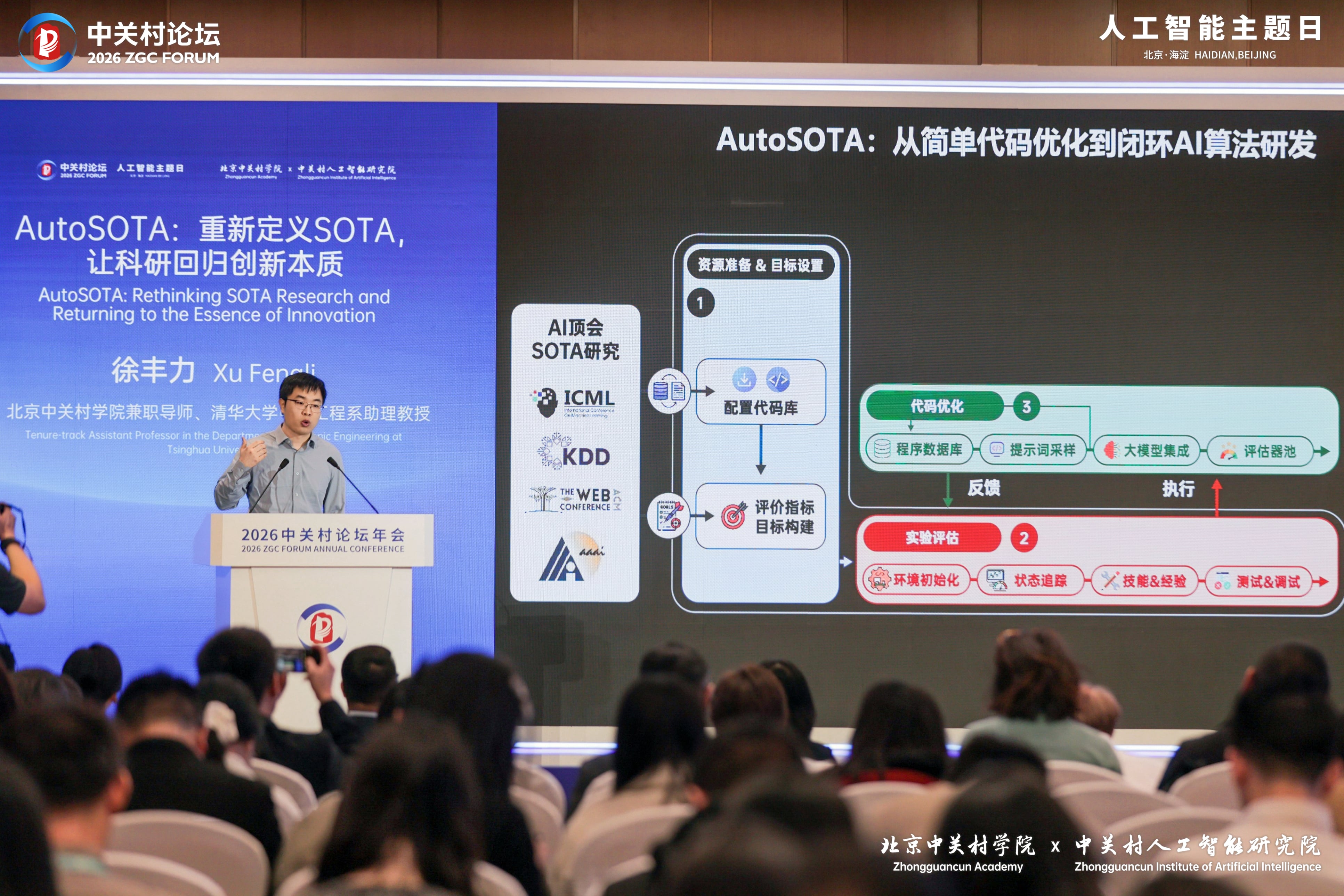
Zhongguancun Academy has officially released its major annual achievement, AutoSOTA, an automated research systems built on top of its OmniScientist AI Scientist system. This project is designed for end-to-end AI research automation and aims to dramatically accelerate the tedious and intensive process of experimental iteration and optimization through AI scientist agents. AutoSOTA adopts a multi-agent collaborative framework that closely simulates the division of labor in human algorithm research. Equipped with a comprehensive toolkit and skill set, it can not only handle a wide range of complex situations arising during experimental execution, but also carry out top-level design through higher-level reasoning such as literature review and innovative ideation, thereby enabling efficient and systematic optimization of AI model performance. In a one-week experiment, building on research from top AI conference papers published over the past year, AutoSOTA successfully discovered 105 SOTA AI models with significant performance gains, of which more than 60% featured novel architectural designs, with an average performance improvement of near 10%.
The significance of AutoSOTA lies not only in pushing performance boundaries, but also in the inspiration it offers for transforming the research paradigm itself. It serves as a 'creativity amplifier' for human scientists, while also prompting us to rethink the essence of scientific innovation: redirecting our most valuable attention away from repetitive experimental iteration and back toward original research that is more disruptive and far harder to replace.
03 Bringing Quantum Chemistry to Real-World Complex Systems
ZGCA·ZGCI Achieves Major Breakthroughs in Large-Scale DFT and TDDFT
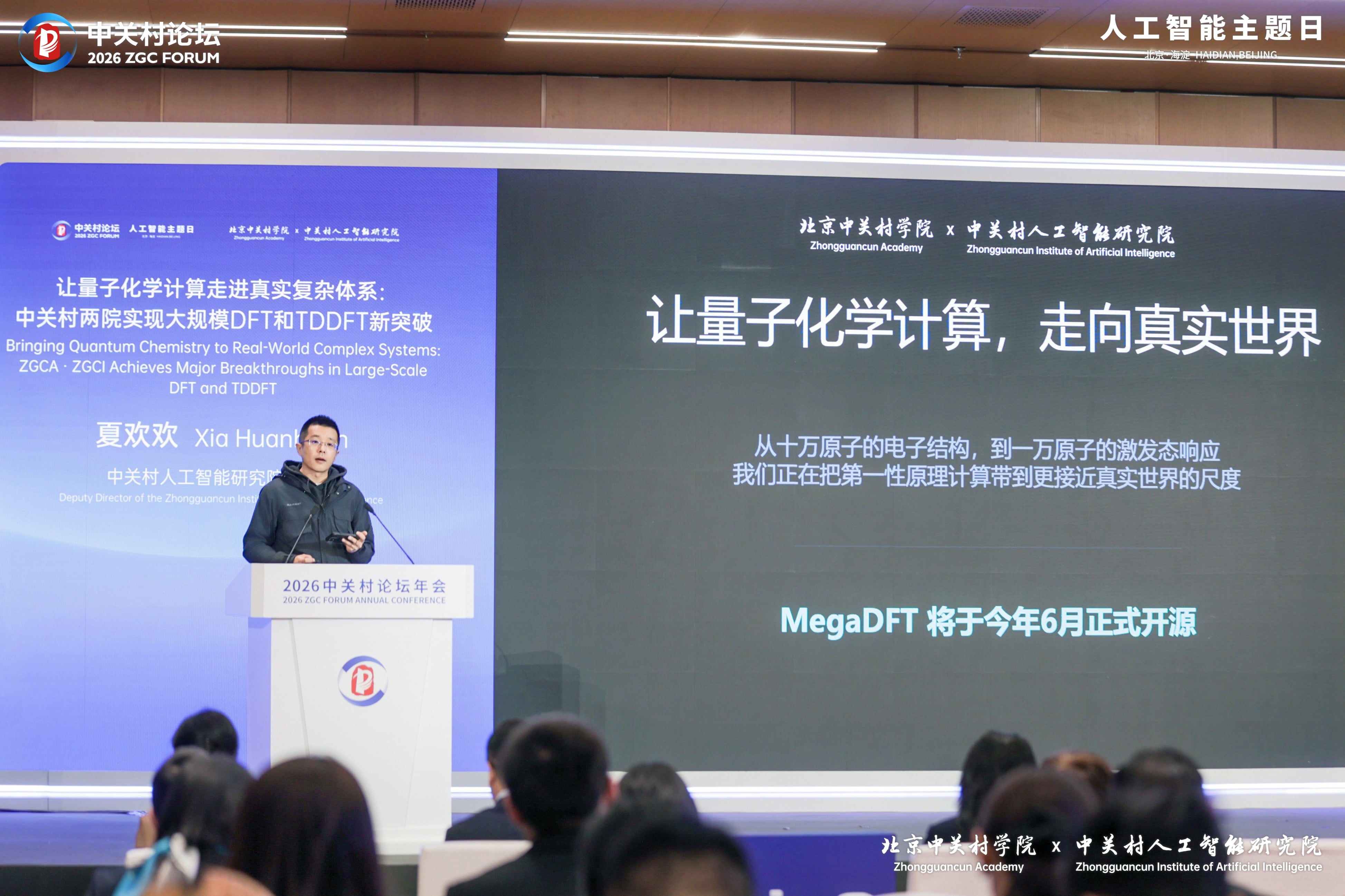
ZGCA·ZGCI has recently achieved a major breakthrough in large-scale first-principles calculations. To overcome the scalability limitations of traditional DFT and TDDFT methods, the team made sustained advances in both algorithmic innovation and engineering implementation—achieving high-precision DFT calculations for non-periodic systems with up to 100,000 atoms, and efficient TDDFT calculations for molecular excited states at the scale of thousands of atoms. The team's proprietary software, MegaDFT, enables rapid construction and decomposition of trillion-scale Hamiltonian matrices, scaling first-principles calculations from the conventional limit of a few thousand atoms to over 100,000 atoms. By further introducing a tensor decomposition approximation, they improved TDDFT computational efficiency by two orders of magnitude, significantly enhancing the ability to simulate excited states and spectral properties of large systems. This breakthrough marks a transition of first-principles calculations from small systems to real-world complex systems, enabling, for the first time, quantitative analysis of ultra-large biomolecules and non-periodic materials with quantum chemical accuracy. The method has broad applications in protein research, fluorescent probes, photosensitive drugs, biological photo processes, and functional optical materials. The results will be fully open-sourced in June this year, making large-scale DFT and TDDFT capabilities widely accessible to both academia and industry.
04 RLinf-USER: An Open-Source Framework for Extensible Real-World Online Policy Learning
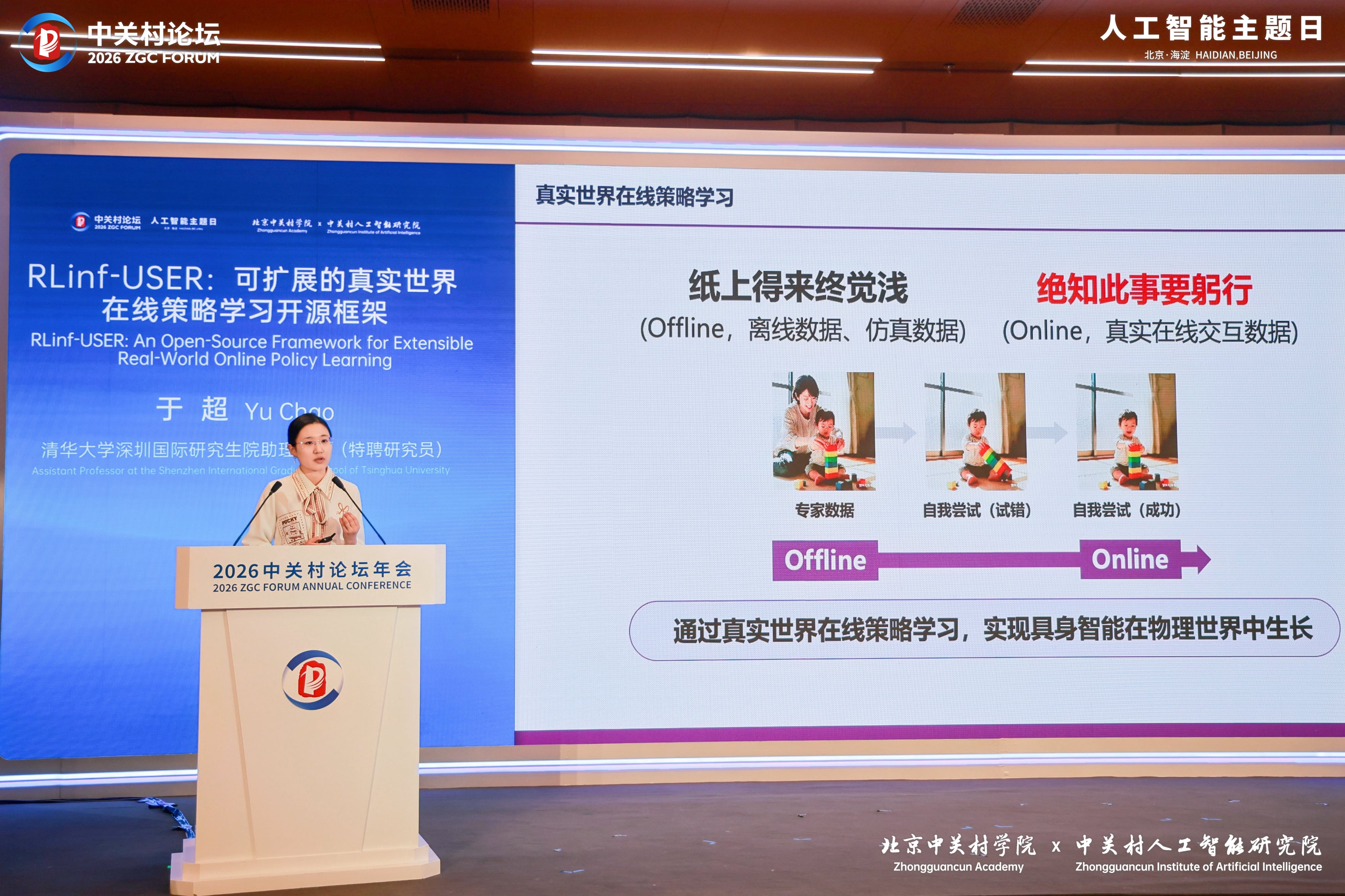
'Practice makes perfect'. For embodied intelligence to achieve real-world deployment, the key lies in continuously learning from real online interaction data. However, existing studies in this field are largely limited to small-scale models or a handful of real robots, which are prone to overfitting and struggle to meet the generalization demands of complex real-world environments. Therefore, online policy learning must scale up to enable the sustained evolution of embodied intelligence in the physical world.
Mainstream large-scale learning frameworks typically rely on the assumption that environments are accelerable, replicable, low-cost, and subject to weak physical constraints. This assumption breaks down in the real world, turning the problem into a deeply coupled system–algorithm challenge. To address this bottleneck, RLinf-USER adopts a co-design approach across both system and algorithm levels. On the system side, it introduces a unified hardware abstraction layer to enable coordinated scheduling of large-scale heterogeneous robotic resources across multiple machines, and builds an adaptive communication plane for cross-domain cloud–edge collaboration, achieving a 3× improvement in communication efficiency. On the algorithmic side, it employs a fully asynchronous training architecture, improving training efficiency by approximately 5× over traditional synchronous methods, and incorporates a persistent buffer with data prefetching to enable efficient indexing and reuse of historical data.
RLinf aims to establish the next-generation training infrastructure for embodied intelligence, forming a closed-loop ecosystem from methodological research to real-world deployment. Its open-source codebase has attracted nearly 3,000 stars on GitHub, received the EAI-100 Annual Top-10 Breakthrough Award, and has been officially integrated into NVIDIA IsaacLab as the first training engine for embodied foundation models. It has also been widely adopted by leading enterprises and research institutions, including AgiBot, X Square Robot, PsiBot, Dexmal, Moore Threads, and D-Robotics, as well as UC Berkeley, HKU, Tsinghua University, Peking University, and Shanghai Jiao Tong University, demonstrating strong practical value and broad adoption potential.
05 Social Simulator: A New Method for Social Science Research in the Age of AI
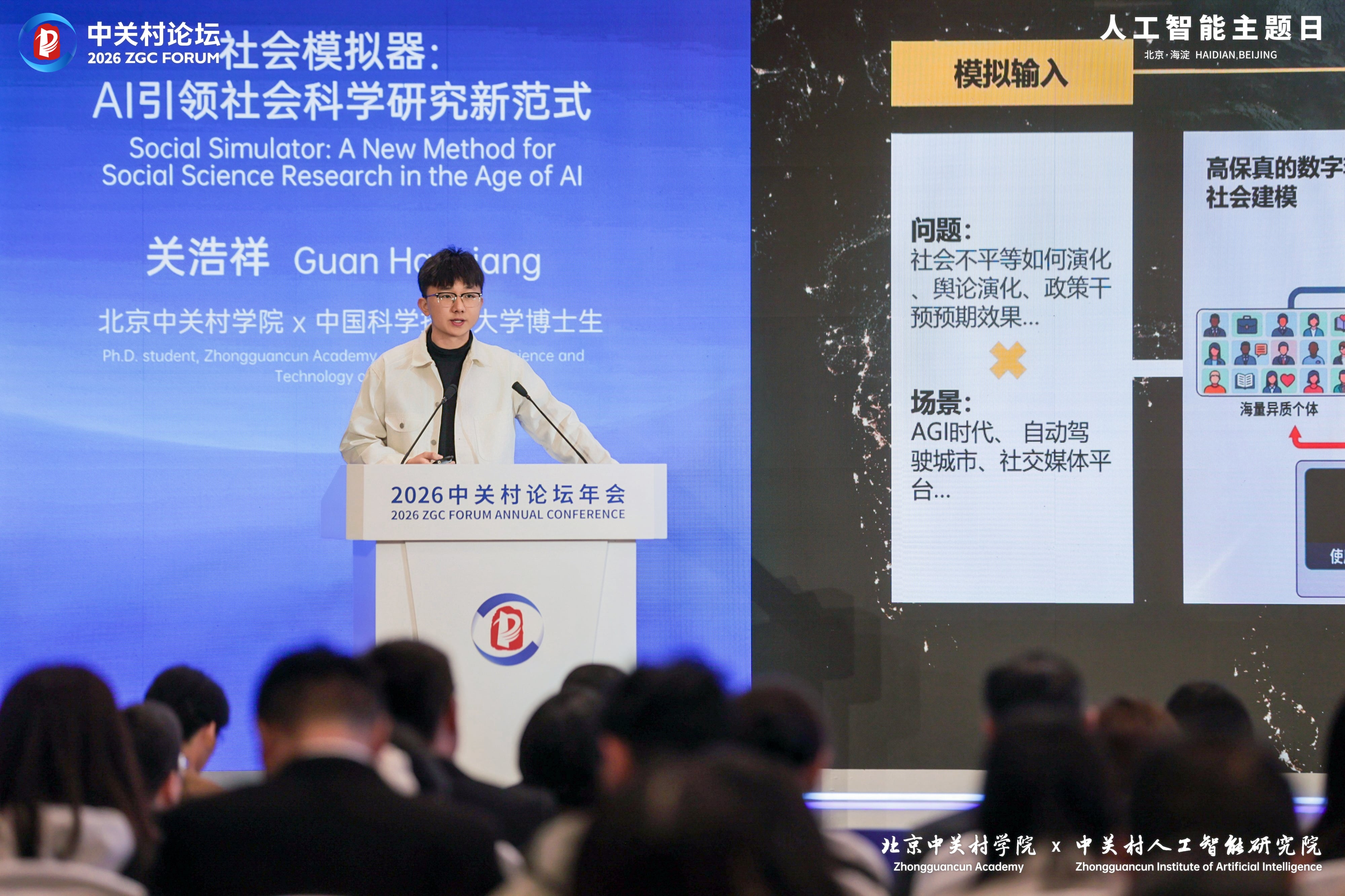
For a long time, the social sciences have faced a fundamental dilemma: society cannot be experimented on in the same way as the natural sciences. In the natural sciences, variables can be controlled in laboratories and results can be repeatedly tested and verified. In contrast, the social sciences have largely been limited to explaining events after they occur—they can neither 'replay' history nor preview the future.
The Social Simulator developed by Zhongguancun Academy seeks to change this. Using large-language-model-driven agents as its fundamental units, it constructs a large-scale digital twin society in which researchers can specify initial conditions, introduce policy interventions, and observe the evolution of society within a virtual world. In doing so, it moves social research beyond 'explaining the past''toward 'simulating the future.'
To achieve this, we have overcome three critical bottlenecks. First, high fidelity: by establishing an individual-level alignment mechanism for intelligent agents, we have advanced simulation from being merely 'macroscopically plausible'to one in which micro-level mechanisms can be rigorously examined. Second, scalability: we have enabled the parallel evolution of billions of agents, bringing simulation closer to the complexity of real societies. Third, broad data integration: through continuous sensing and the fusion of multi-source heterogeneous data, we provide simulations with information inputs that closely approximate the real world. This approach has already been validated in public-opinion simulations at the scale of tens of millions, offering the social sciences a new paradigm that is experimental, reproducible, and predictive.